The Stone Lord's Secret: How Minsc Survived a Century in Baldur's Gate 3
Minsc's ageless look in Baldur's Gate 3 stems from a century as a statue, freed by wild magic.
Long after the Bhaalspawn crisis faded into legend, the city of Baldur’s Gate whispered of a stone figure standing forgotten in its slums. It bore the proud silhouette of a ranger with a hamster tucked into his collar, a frozen monument to a hero lost to time. In 2023, when Larian Studios unleashed Baldur’s Gate 3 upon the world, that story finally found its conclusion—and by 2026, players still marvel at how a mere human could stride into the Absolute crisis looking barely a day older than when he petrified an entire tavern with his battle cry a hundred years earlier.
Minsc is no stranger to being a paradox. He wields a two-handed sword with the same enthusiasm a child reserves for a new toy, and his miniature giant space hamster, Boo, offers tactical advice that somehow makes sense only in the realm of the truly absurd. Yet even in a franchise where elves measure their age in centuries and druids cheat time like a river that loops back on itself, the ranger’s eternal youth caught everyone off guard. Jaheira, his longtime friend and occasional scold, now carries the weight of decades in the silver lining her hair. Viconia DeVir, the drow priestess who once walked beside them, has aged visibly despite elven blood—her features sharpened by bitterness as if each betrayal carved a new line on her face. Against this backdrop, Minsc looked like a painting shielded from sunlight while the world around it cracked and faded.
The explanation, when it finally surfaced, was as peculiar as Minsc himself. Jaheira let the truth slip early in Act Three, mentioning that Minsc had spent over a century as a statue. It was not a metaphor for emotional paralysis or a clever turn of phrase. Minsc, the Rashemi ranger who headbutted his way through the Sword Coast’s deadliest threats, had been literally turned to stone. The confession hung in the air like a note plucked from a lute string that never should have been there—a backstory tidbit so strange that it could only belong to a mascot of Dungeons & Dragons.
Minsc confirmed the tale himself at camp, his voice carrying the same booming cheer as ever. After the Bhaalspawn saga concluded, he and Boo had returned to Baldur’s Gate, only to be ambushed. He never learned the identity of his attacker, musing that any number of villains he had \"angered too much\" might have sought revenge. The next thing he knew, he was a statue in the slums, Boo somehow preserved alongside him in miniature stasis. For over a hundred years, he was a decorative sentinel watching the city’s refuse pile up around his ankles, a fossil of good intentions.
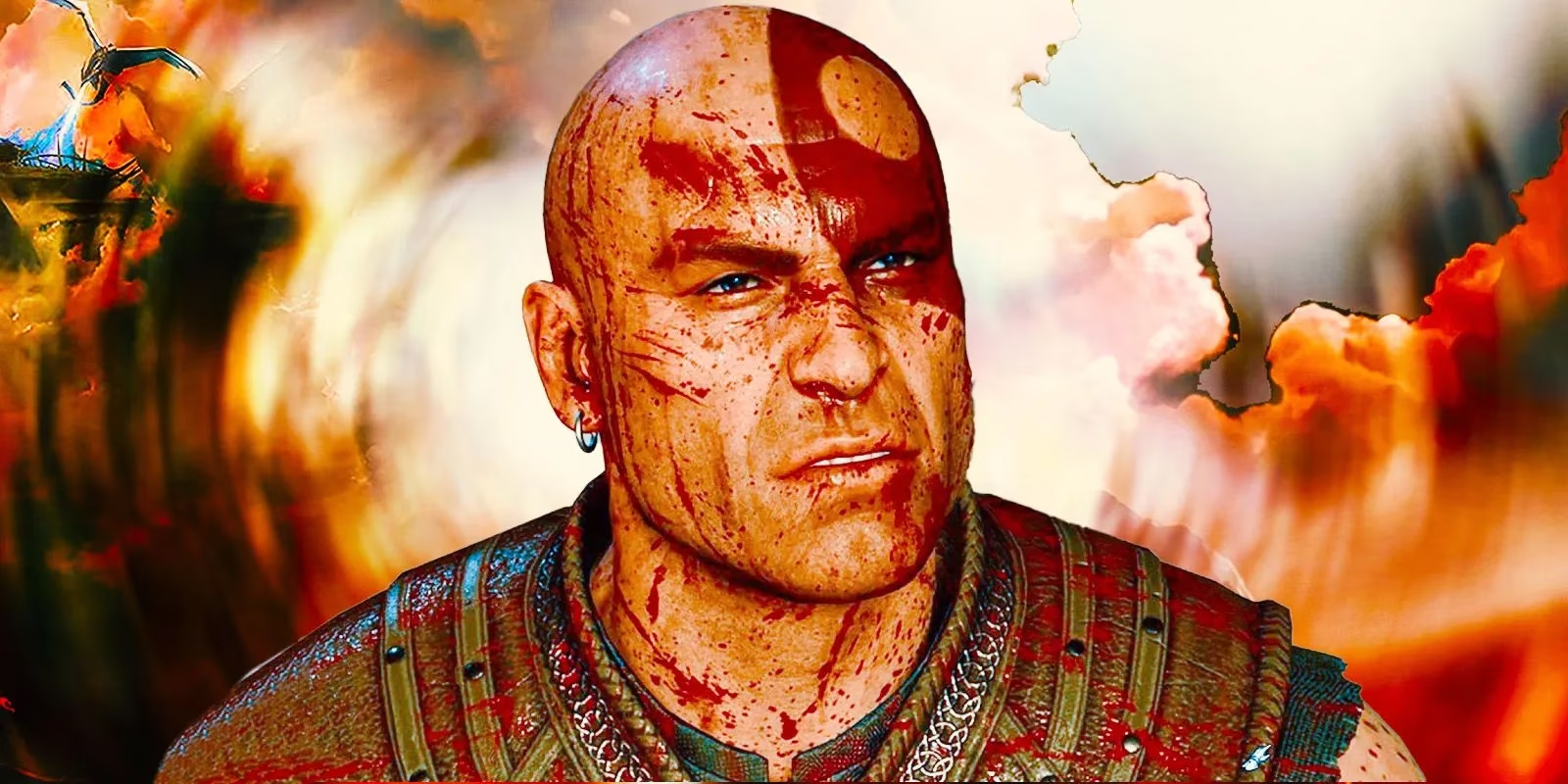
What shattered that stony prison was not a high-level dispel or a carefully planned ritual, but chaos in its purest form. A Wild Magic sorcerer named Deliana wandered too close, her unstable arcana spitting out a surge that accidentally reversed the petrification. It was the magical equivalent of a lightning strike reanimating a corpse—statistically improbable, narratively perfect. Minsc blinked back into existence as if waking from a nap, dusted off his shoulders, and asked Boo if they had missed lunch. The century that stole Jaheira’s youth and twisted Viconia into a cult leader’s grim parody had, for him, been a single unbroken dream of hamster-related heroics.
This bizarre loophole spared him more than just wrinkles. While other companions from the original Baldur’s Gate games met fates dark enough to curdle blood, Minsc remained untouched by the corrosive passage of time. Viconia founded a Sharran enclave in Waterdeep and, on her goddess’s command, slaughtered everyone inside—a scream of devotion that left her soul in tatters. Sarevok clawed his way back from death so many times that his very cells seemed to hum with desperation. Yet Minsc, once freed, simply resumed being Minsc. He formed a new party, carved a reputation as the Stone Lord of the criminal underworld, and even ventured into Avernus as a sellsword without ever breaking stride. The missing century was not a loss to him; it was a skipped chapter in a book he never bothered to read.
When the Absolute began its psychic crusade, the ranger fell under the cult’s sway, manipulated by a false Jaheira puppet and turned against the city he once saved. Players encountered him not as a friend but as a weapon, his mind wrapped in tendrils of mind flayer influence like a sword rusting in someone else’s hand. The real Jaheira’s desperate campaign to rescue him became one of the most heartfelt threads in Baldur’s Gate 3—a druid fighting not just the Absolute, but the weight of a friendship that had outlasted empires.
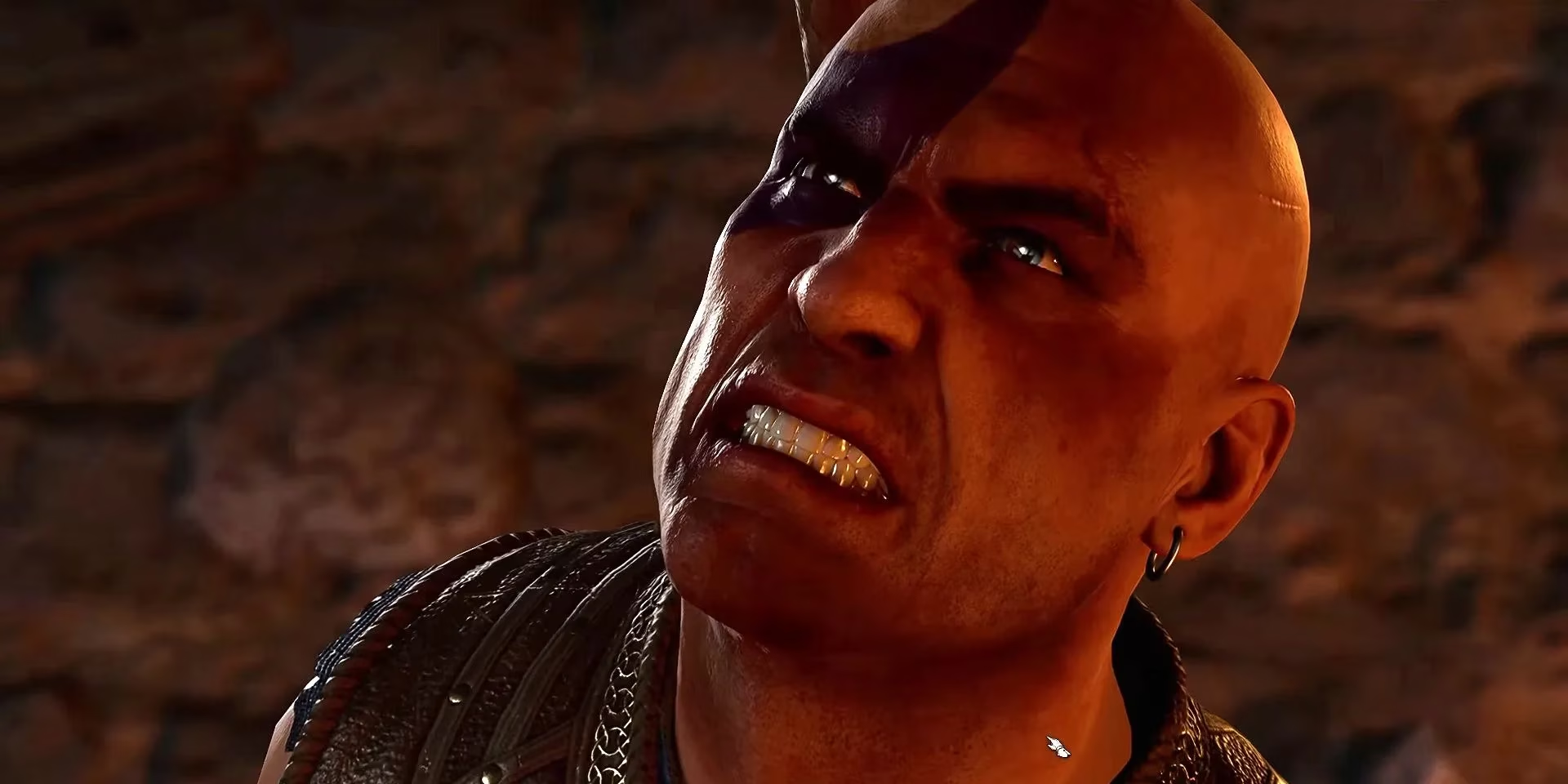
Larian Studios understood the mythic weight Minsc carried. Having Matthew Mercer voice the ranger was a masterstroke, bridging the gap between the grognards who had adventured with him on 1998’s pixelated Sword Coast and the new generation streaming their playthroughs in 4K. By 2026, the choice feels even more prescient—Mercer’s delivery, equal parts earnestness and ham, became the auditory glue that held Minsc’s absurdity together. When Minsc declares that \"Boo sees evil,\" it is not a joke landing flat but a creed spoken with such conviction that the listener almost believes the hamster really is the brains of the operation.
The petrification backstory also serves a deeper narrative purpose. In a saga obsessed with the scars that time inflicts—Shadowheart’s erased memories, Astarion’s centuries of torment, Karlach’s decade in the Hells—Minsc stands as a counterpoint. He is a living fossil, but one whose fossilization preserved him rather than imprisoned him. Time in the Baldur’s Gate universe chews through everything: empires crumble, gods die, and even the Bhaalspawn legacy eventually fades into dusty prophecy. Minsc side-stepped that erosion entirely. He re-entered the story at the precise moment his particular brand of straightforward heroism was needed, a relic who never became obsolete.
Yet for all the smiles Minsc brings, there is melancholy beneath the stone. Jaheira lost a century with her dearest friend and cannot get it back. She gazes at him sometimes with the look of an archivist handling a manuscript that should have crumbled long ago—a mixture of gratitude and sorrow for the years they did not share. Minsc remains blissfully unaware, fixated on the next enemy to smite and the next piece of cheese to feed Boo. The asymmetry of their bond makes their reunion all the more touching: she aged, he waited, and when the statue cracked open, the same Minsc she remembered stepped out, unchanged and utterly, wonderfully himself.
Even in 2026, as modders continue to inject new life into the game and the lore expands through sourcebooks, Minsc’s petrification remains one of Baldur’s Gate 3’s most elegant narrative solutions. It honors the past without being shackled to it, turning what could have been a glaring continuity error into a badge of the ranger’s chaotic destiny. Minsc does not defy time through magic, divine favor, or contractual immortality—he survived simply because the universe, in a fit of Wild Magic-sized irony, forgot to let him die. And in a franchise built on the notion that even gods can have their portfolio stripped away, that is perhaps the most Dungeons & Dragons ending of all.