The Self-Same Trial: What Baldur's Gate 4 Must Learn from Mirror Matches
Baldur's Gate 3 Self-Same Trial delivers a gripping mirror battle, testing party builds and strategy in the Gauntlet of Shar.
I still remember the first time the Gauntlet of Shar forced me to fight myself. It was Act Two of Baldur's Gate 3, and I had already survived shadow-cursed lands, creeping horrors, and a few decisions I would rather not explain to my party. Then the Self-Same Trial arrived, and suddenly my greatest enemy was not a mind flayer or an absolute cultist. It was me, wearing my armor, holding my weapons, and using my own build against my friends. The encounter felt like stepping into a hall of mirrors where every reflection had a knife and a grudge.
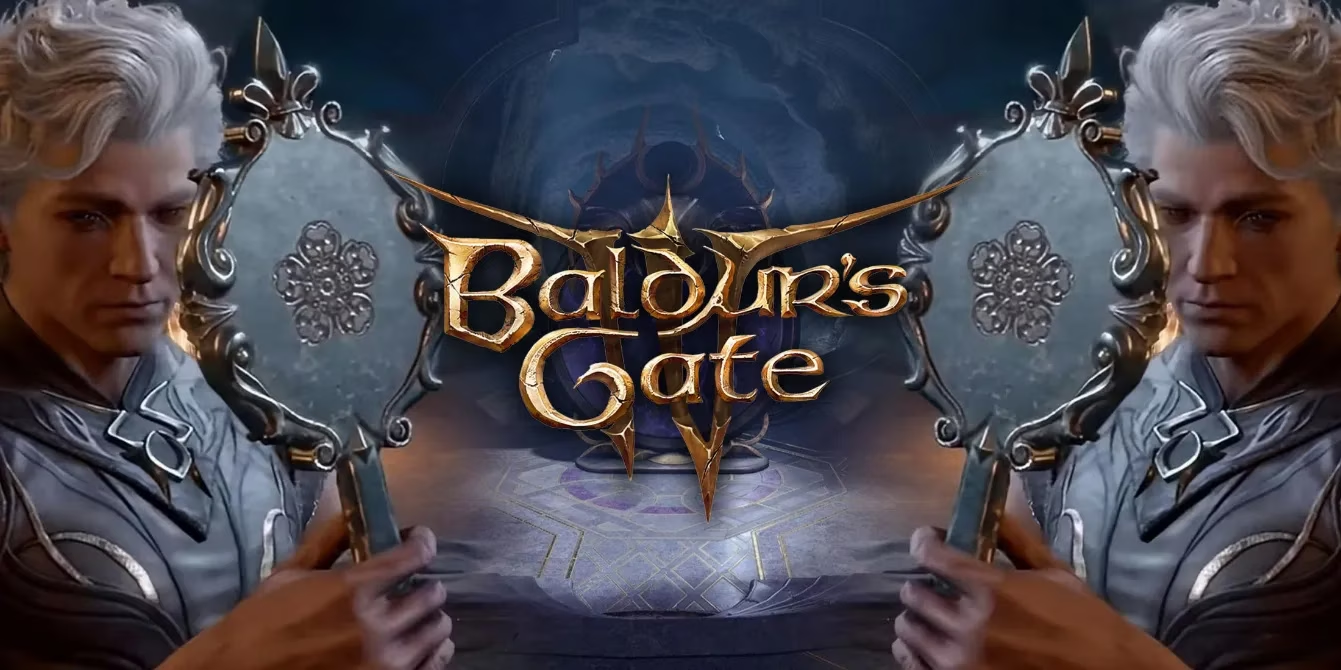
The Self-Same Trial is one of the most memorable dungeons in Baldur's Gate 3 because it does more than copy-paste enemies. Each mirror version reflects a party member, which means the fight becomes a brutal pop quiz on how well you actually understand your own builds. If you built a rogue around sneak attacks, your mirror rogue knows that trick too. If your wizard loves stacking spells, your mirror wizard is ready to return the favor. The game punishes you for damaging a mirror copy that is not your own, so you cannot simply blast everything and hope for the best. You have to identify your counterpart, isolate them, and dismantle them before the rest of the mirrored party outsmarts you.
That penalty mechanic is brilliant because it turns the encounter into a tactical puzzle. If one mirror version falls, its counterpart is free to help the rest of the team. That pressure forces quick decisions, resource management, and a kind of desperate improvisation that I usually reserve for tabletop sessions gone sideways. The AI in Baldur's Gate 3 also deserves credit here. My mirror counterparts used sneak attacks, spell stacking, and clever item usage that I had overlooked in my own gameplay. Fighting them felt like playing chess against a version of myself that had read my diary and memorized my favorite openings.
What makes the Self-Same Trial stick with me is not just the difficulty. It is the humiliation and the revelation. I thought I knew my party. Then my mirror bard controlled the battlefield better than I did, and my mirror fighter punished every bad position I had ever taken for granted. The encounter exposed the gaps in my build knowledge while also showing how deep Larian Studios' combat design can be. It was a mirror match in the truest sense, and it arrived at a point in the story where resources already felt thin and every spell slot mattered.
If Baldur's Gate 4 includes another mirror battle, it cannot simply repeat the trick. It has to raise the stakes. In Baldur's Gate 3, the Self-Same Trial worked because it was one challenge inside the Gauntlet of Shar, a sequence of trials tied to Shadowheart's narrative. For a future game, a mirror battle could stand on its own, outside a multi-trial gauntlet. That would give players more room to focus on the mechanics without being distracted by additional objectives. It could become a personal turning point, not just another room in a dungeon.
Here is where I think the next game could improve:
| Feature | Baldur's Gate 3 Self-Same Trial | Baldur's Gate 4 Opportunity |
|---|---|---|
| Mirror fidelity | Strong, but sometimes inaccurate for multiclass builds | Perfectly reflect multiclass choices, feats, and item synergies |
| Wrong-target penalty | Damaging another person's mirror hurts the player | Expand the penalty into a narrative consequence or timed debuff |
| Cheese prevention | Players could remove gear to weaken clones | Penalize gear removal or create adaptive clones that scale with intent |
| Narrative placement | Tied to the Gauntlet and Shadowheart's story | Place at a pivotal personal moment for the protagonist or companion |
| Emotional impact | Tactical shock with some story context | Full emotional crisis, forcing players to confront their choices |
One area where Baldur's Gate 3 left room for improvement is multiclassing. Some players reported that their mirrors had access to different abilities than they did. That suggests the system could not always mirror the full complexity of a character. For Baldur's Gate 4, accuracy matters. If I spend hours crafting a bizarre multiclass monster, I want my mirror to be just as bizarre and just as monstrous. I want to see my own nonsense reflected back at me, not a simplified approximation.
Another controversial but necessary change would be to remove the ability to cheese the battle by removing gear before entering. In Baldur's Gate 3, some players figured out that stripping their party could weaken their clones. That is clever, but it undermines the fantasy. A mirror match should test your build, not your willingness to undress before a holy trial. Baldur's Gate 4 could penalize gear removal, or it could make the clones adapt to the player's intent rather than their current equipment.
Most importantly, the next mirror battle needs emotional weight. In Baldur's Gate 3, the fight is tied to the Gauntlet of Shar and Shadowheart's overall narrative, but it could have been even more personal. Imagine facing your mirror at the moment you betray a companion, abandon a promise, or embrace a dark power. That would feel like a bad dream that had learned my combat log by heart. The fight would no longer be just a clever encounter. It would be a confession.
Baldur's Gate 4 has a high bar to clear if it includes a mirror battle. The Self-Same Trial in Baldur's Gate 3 combined tactical depth with intelligent design, and it remains one of the definitive encounters of the game. As of 2026, players still argue about the best ways to beat it, which builds break it, and which companions suffer most when their clones turn on them. The challenge for a future game is not to replicate that success. It is to push it further, to make the mirror not just a copy, but a judgment. With the right approach, Baldur's Gate 4 could cement the mirror battle as one of the defining moments of the next RPG era. 🎭⚔️🪞