Critical Role’s First Game Seizes the Golden Age of CRPGs in 2026
Critical Role's first video game arrives in 2026, riding the D&D renaissance and story-driven CRPG wave shaped by Baldur's Gate 3.
The long-running tabletop phenomenon Critical Role has never been more than a single dice roll away from its next evolution. Since a quiet tease dropped by CEO Travis Willingham in late 2024, the company’s first dedicated video game has moved from \u201cbehind the scenes\u201d to a tangible project riding a wave no one could have predicted a decade ago. In 2026, as the Dungeons & Dragons renaissance crests and story-first gaming eclipses bloated live-service models, the timing of this interactive debut feels less like a calculated move and more like a narrative twist the show\u2019s own Dungeon Master, Matthew Mercer, might have written.
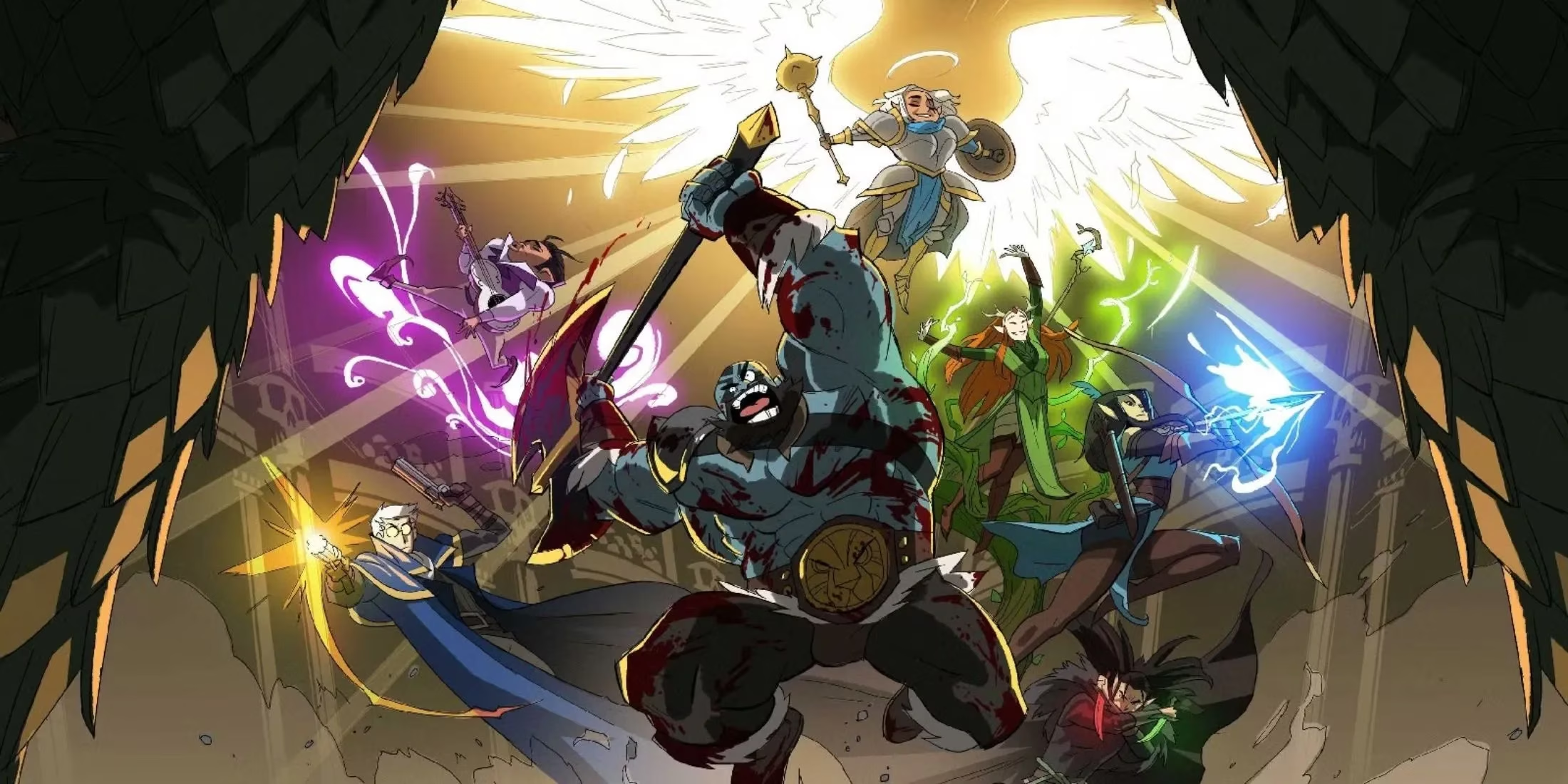
When Willingham spoke to Rolling Stone barely two years ago, he described a game industry in upheaval\u2014one where the old hierarchies of popularity were cracking like a frozen lake in spring. That fracture has only widened. Blockbuster studios have stumbled under the weight of unsustainable budgets, while mid-tier and indie projects have claimed the spotlight with surgical precision. The emblem of that shift remains Larian Studios\u2019 Baldur\u2019s Gate 3, a turn-based CRPG that snagged Game of the Year in 2023 and continues to influence design trends well into 2026. Its success acted as a seismic tremor, rearranging the landscape so thoroughly that sprawling fantasy narratives with complex mechanics are no longer niche; they are expected.
In this freshly tilled soil, Critical Role\u2019s project plants itself like a seed bred for exactly these conditions. The show\u2019s decade-long fanbase has matured alongside the medium, and many of the voice actors who bring Exandria to life\u2014Laura Bailey, Liam O\u2019Brien, Sam Riegel, and Mercer himself\u2014have already lent their talents to games that define the CRPG resurgence. Mercer\u2019s turn as Minsc in Baldur\u2019s Gate 3 was more than a cameo; it was a symbiosis, a bridge between tabletop improvisation and reactive digital storytelling. It\u2019s nearly unthinkable that Critical Role\u2019s game would veer away from the role-playing core that made its name, and every whisper from Darrington Press suggests a dense, choice-laden experience that could lean into the Early Access model Baldur\u2019s Gate 3 perfected, inviting fans to shape the story just as a live D&D table would.
What fuels the confidence that 2026 is the perfect launch window isn\u2019t just nostalgia or anniversary momentum\u2014the show\u2019s tenth year landed in 2025 with a festival of announcements\u2014but the genus of the games that surround it. The one-two strike of Disco Elysium and Baldur\u2019s Gate 3 did not merely open a door; they vaporized the wall separating \u201chardcore\u201d CRPGs from mass audiences. A genre once content to whisper in dusty libraries now howls at center stage. Titles like Obsidian\u2019s Avowed and other isometric revivals command attention, and players who cut their teeth on simplified AAA RPGs are hungrier than ever for depth that respects their intelligence. A Critical Role CRPG, steeped in the lived chemistry of its cast, could alchemize that hunger into a phenomenon that rivals the very tabletop streams that birthed it.
Yet the broader ecosystem provides an even more pragmatic reason. Willingham\u2019s observation about industry upheaval has proven prophetic: in 2026, talent and creativity are migrating toward studios that will not crush vision under corporate weight. A Critical Role game, likely developed in partnership with a boutique studio or even under its own Metapigeon umbrella, can bypass the sludge of annualized sequels. Darrington Press has already proven the company can craft rulesets and worlds\u2014Candela Obscura and Daggerheart show an appetite for mechanical innovation\u2014so the digital leap could arrive bearing its own distinct systems, not just a licensed coat of paint.
Of course, the risks remain as sharp as a concealed blade. A fixed-camera CRPG can still alienate players who prefer behind-the-shoulder immediacy, and a story too intertwined with hundreds of hours of broadcast lore might daunt newcomers. But the path Baldur\u2019s Gate 3 blazed is exactly the sort that rewards boldness. Its Early Access years were an uninterrupted dialogue with a community, a cadence Critical Role already understands intimately from thousands of hours of live audience feedback. That shared language\u2014between cast, characters, and community\u2014is the same alchemy that turned a home game into a media empire. It may now transform a video game into a milestone not just for fans of Critical Role, but for a genre finally standing in the sun after decades in the underdark.