Avowed's Character Creator: How Godlike Features Could Redefine RPG Customization
Avowed's revolutionary 2026 character creator shatters RPG norms with its 'Godlike' mechanic, empowering players to craft uniquely bizarre and monstrous protagonists through profound divine manifestations like fungal growths and lithic skin.
As we look ahead to Obsidian Entertainment's upcoming action-RPG Avowed in 2026, I can't help but reflect on how far character creation has come. The game is set in the same rich fantasy universe as the Pillars of Eternity series—a world called Eora that's woven with deep history and intricate lore. What truly captures my imagination, however, is how Avowed is poised to turn a fundamental aspect of its world-building into a revolutionary player experience. Unlike traditional RPGs where you might choose a deity or blessing, here you begin as a 'Godlike'—an individual whose spirit was touched by one of Eora's eleven gods before birth. The twist? You won't know which god blessed you. This simple narrative hook opens the door to what could be one of the most distinctive character creators in recent memory.
Let's talk about the current landscape. Over the past few years, we've witnessed character creators evolve from basic template pickers to incredibly detailed sculpting tools. Baldur's Gate 3 in 2023 set a high bar with its staggering breadth of options—every facial feature, body proportion, and personality trait felt customizable. Then came Dragon's Dogma 2 last year, which let players adjust details as minute as the spacing between teeth. These tools have empowered players to craft protagonists that are either strikingly lifelike or wildly imaginative. Yet, despite these advances, most systems still operate within a framework of 'conventional' beauty or heroic archetypes. Avowed appears ready to shatter that mold entirely.
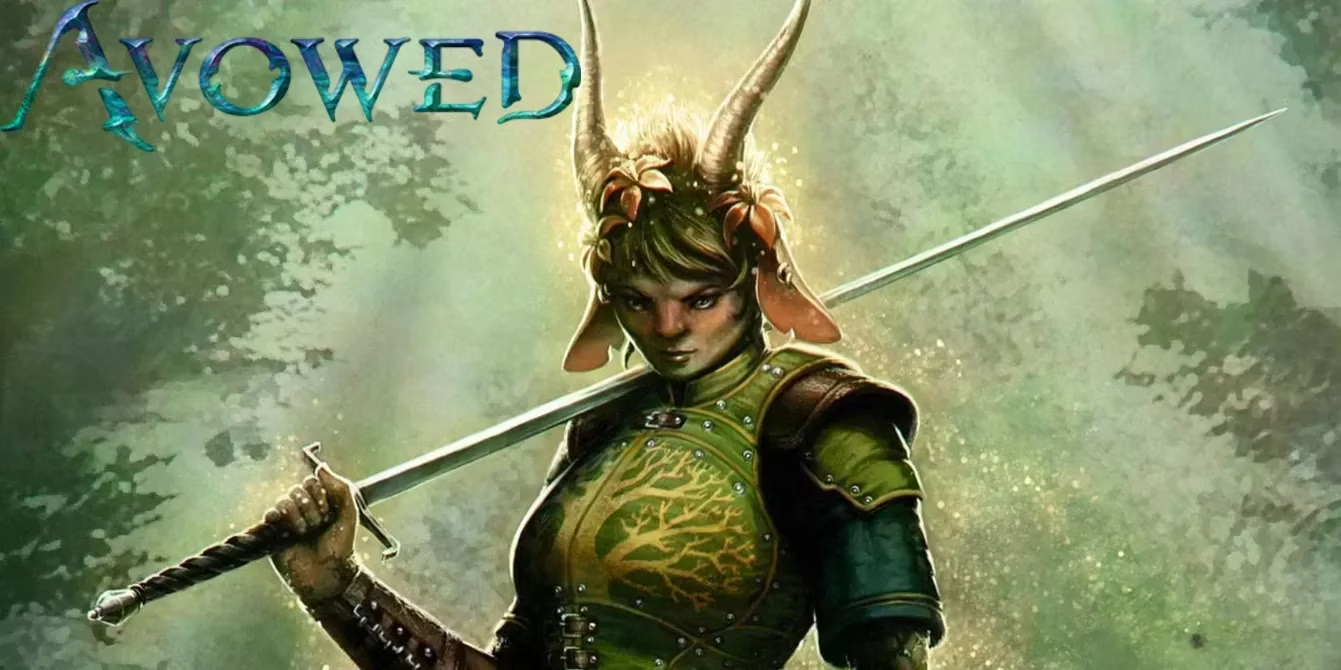
What fascinates me most is how Avowed's Godlike mechanic directly engages a player archetype often overlooked: the creators of the bizarre, the uncanny, and the outright monstrous. In many RPGs, players who want to design truly aberrant characters must work against the system, pushing sliders to their extremes to achieve grotesque or unnatural looks. Avowed, however, seems to be baking this possibility into its core design. Based on previews and developer insights, the Godlike features aren't just cosmetic overlays—they're profound physical manifestations of divine influence. Imagine crafting a character with a massive fungal colony sprouting from their skull, or with crystalline formations replacing hair, or with skin that resembles petrified wood. These aren't mere tattoos or accessories; they're integral to the character's identity and origin.
Obsidian hasn't revealed the full list of Godlike features, but the glimpses we've seen are tantalizing. A recent showcase depicted characters with:
-
Cranial fungal blooms – large, intricate mushroom beds growing from temples and scalps
-
Lithic skin patterns – skin that appears cracked like stone or earth, glowing with inner light
-
Floral hair replacements – where hair should be, instead there are vines, moss, or glowing lichen
-
Lunar crests – crescent-shaped bony growths protruding from the forehead, shimmering with pale light
-
Ethereal auras – subtle, persistent visual effects like drifting sparks or swirling mist around certain body parts
This approach does more than just offer visual variety; it embeds narrative into aesthetics. Your character's appearance becomes a puzzle piece in the larger mystery of their divine patron. Is that crystalline growth a sign of Gaun's influence, the god of truth and light? Or does the fungal symbiosis hint at a connection to the natural, often brutal, cycles overseen by Hylea? The game reportedly won't tell you upfront, making discovery part of the journey.
Now, let's contrast this with the standard RPG creator blueprint. Typically, you'd select a race, tweak a face, choose a hairstyle, and maybe pick a scar or two. Avowed promises all those foundational options too—race selection (likely including humans, elves, dwarves, and orlans), background choices that affect skills and dialogue, and voice selection. But the Godlike features sit on top of this framework as a transformative layer. They remind me that RPGs are at their best when mechanics and story are inseparable. Here, your visual design isn't just about vanity; it's a core part of your character's unknown backstory and potential future.
I believe this could set a new precedent. While Baldur's Gate 3 excelled in volume of choice and Dragon's Dogma 2 in granular physical control, Avowed might be pioneering a new direction: thematic and narrative-driven customization. Instead of just asking 'What does my character look like?', it asks 'What does my character's divine mystery look like?'. This shifts the creative goal from achieving realism or idealized fantasy to expressing a unique, in-world supernatural concept.
Of course, the success of this system hinges on execution. The features need to feel meaningful, not just tacked on. They should influence gameplay perceptions—perhaps through unique dialogue options, NPC reactions, or even subtle environmental interactions. If a character with fiery volcanic rock for skin walks through a rainy forest, does the steam rise off them? If they have fungal growths, do forest creatures behave differently? These small touches would elevate the Godlike concept from a cool visual gimmick to a living, breathing part of the game world.
Looking at the broader picture, Avowed's approach feels timely. In 2026, players crave depth and identity in their digital avatars. We've moved beyond wanting just a 'pretty' hero; we want a hero with a story etched into their very form. By making the bizarre and the divine not just possible but a central, celebrated option, Obsidian is validating a whole spectrum of player expression. It sends a message: in the world of Eora, you don't have to be conventionally heroic to be compelling. You can be strange, unsettling, otherworldly—and that itself can be the source of your power and narrative.
As I await Avowed's release, I'm already brainstorming character concepts. Will I create a stoic warrior whose stony hide tells a tale of mountain gods? Or a mystic whose hair is a cascade of glowing moss, hinting at deep forest magic? The possibilities feel boundless because they're tied to a rich lore that encourages wonder and mystery. In an era where character creators often strive for hyper-realism, Avowed dares to be gloriously, meaningfully weird. And that, to me, is where true role-playing magic begins.